Before the Box: Twelve Hours Inside a Working Jewelry Studio
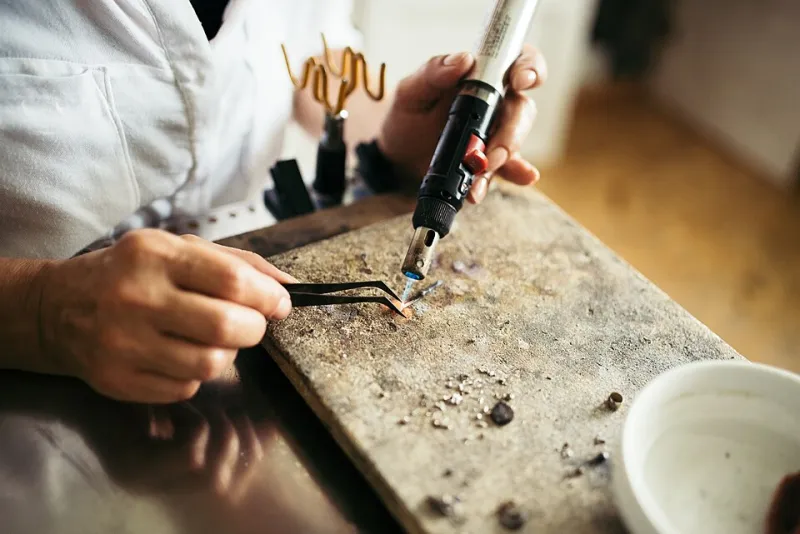
Photo: Shixart1985, CC BY 2.0, via Wikimedia Commons
There's a moment in every jewelry studio, usually around 7:45 a.m., that nobody photographs for Instagram. The bench is quiet. The coffee is hot. And a jeweler is staring at a sketch that looked brilliant last night and slightly terrifying this morning.
We spent a full day at the bench with a working American jewelry studio to trace the life of a single piece — a hand-fabricated ring, from first pencil line to final polish — and what we found was messier, funnier, and far more human than any 'handcrafted' marketing copy would have you believe.
It Starts With Paper, Not Metal
Before a single gram of gold is touched, there's the sketch. And according to nearly every jeweler we've ever met, the sketch is where most of the real decisions happen.
"Anyone can draw a pretty ring," our host told us, adjusting a jeweler's loupe that has clearly lived on that desk for a decade. "The question is whether a pretty ring survives contact with real hands. Can you open a jar? Type on your phone? Hug your kid without scratching them? That's the design brief nobody writes down."
The morning's sketch went through four revisions before lunch. Three were minor — a bezel pulled a hair thinner, a shank tapered slightly differently. One was a full rethink after realizing the stone would sit too high for someone who, in the client's words, "knocks on doorframes for a living."
The Bench: Where Good Intentions Meet Physics
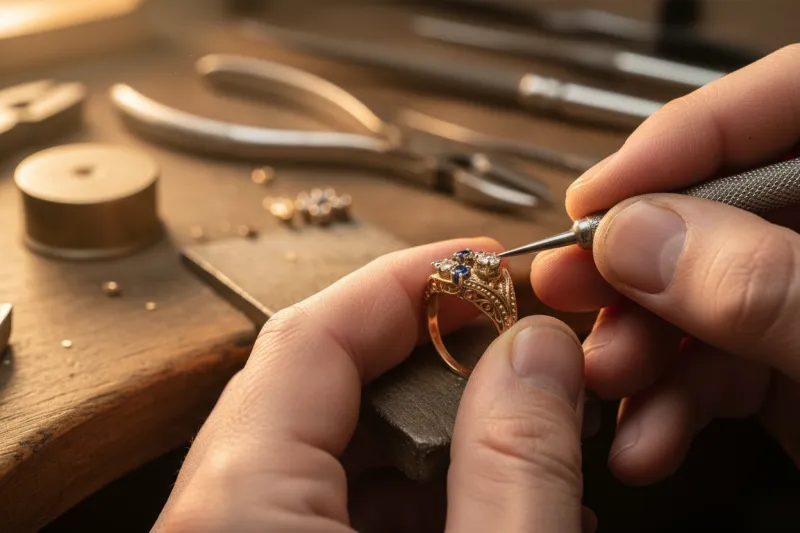
By mid-morning, the studio sounds like a very polite machine shop. The flex shaft hums. Files whisper against metal. There's a wax model being shaped with a heated tool that looks suspiciously like a dental instrument (because it is one — jewelers are notorious for borrowing from dentists).
The tools themselves tell a story. Some are older than the jeweler. A set of pliers inherited from a mentor. A bench pin worn into a saddle shape by years of sawing. In an era when so much of what we buy is anonymous, this is the opposite: a workspace that is essentially an autobiography.
And then — because no honest studio tour skips this part — a mistake. A saw blade snaps mid-cut. It's not dramatic. There's no swearing fit. There's a small sigh, a new blade threaded through the saw frame, and a restart of a cut that took maybe ninety seconds.
"People think craftsmanship means never messing up," we were told while sweeping metal dust. "Craftsmanship means messing up cheap and early. That's the whole game."
The Invisible Ninety Percent
Here's what struck us most by mid-afternoon: the finished piece — the thing that will eventually sit in a velvet box and get an "oh my god" at the right moment — represents maybe ten percent of the visible work. The rest is invisible and unglamorous:
- Sizing and re-sizing. A ring that fits on paper doesn't fit on a finger with knuckles. Real fingers have opinions.
- Pre-polishing. Hours of sanding with progressively finer grits, none of which show up in the final product except as a vague, lovely glow.
- Soldering seams you'll never see. Every joint melted, cleaned, filed, and sanded until the metal forgets it was ever two pieces.
This is also, quietly, the answer to "why does handmade cost more?" You're not paying for the gram of metal. You're paying for the ninety percent nobody photographs — and for the years of failures that taught the maker where the failures hide.
The Polish, and the Strange Quiet After
By early evening, the ring is done. Final polish, ultrasonic bath, a last inspection under bright light at 10x magnification. The jeweler holds it up, turns it once, twice.
And then does something we didn't expect: sets it down and walks away.
"You have to look at it fresh tomorrow," came the explanation. "Tired eyes approve anything. If I still like it in the morning, it ships."
That, maybe more than anything, is the difference between handwork and mass production. A factory optimizes for consistency. A studio optimizes for a single standard: would the maker be proud to hand this to someone they know?
Why This Matters to Your Jewelry Box
You don't need to commission a custom piece to benefit from knowing how this works. Understanding the process changes how you shop:
Ask about the maker. Small studios and independent designers can usually tell you exactly who made your piece and how.
Respect the timeline. If a "custom" piece can be in your hands in 48 hours, someone skipped the invisible ninety percent.
Budget for the process, not just the product. Handmade pricing reflects skill, time, and a studio's real overhead — not a markup mystery.
The ring we watched come to life won't have a barcode. It'll have a story — about a snapped saw blade, a doorframe-knocking client, and a jeweler who walked away from a finished piece and came back the next morning to make sure it deserved to leave.
That's not a marketing angle. That's just a Tuesday at the bench.