Someone Else's Story, Your Setting: The Honest Guide to Redesigning Inherited Jewelry
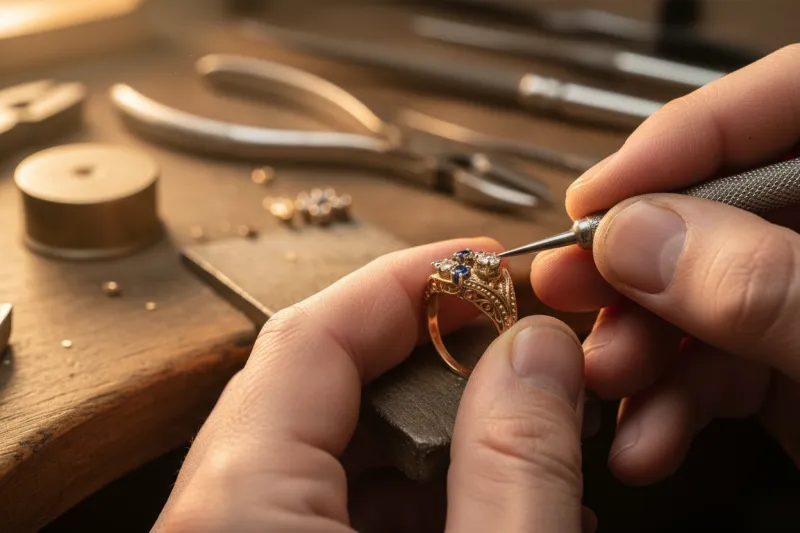
Photo: vintage heirloom diamond ring being redesigned antique jewelry close up, via champaignjewelers.com
Let's start with a confession from the jewelry world: the most common thing people do with inherited jewelry is nothing.
It sits in a drawer, or a safety deposit box, or the original box it came in forty years ago — too meaningful to sell, too dated (or too fragile, or too 'not me') to wear. Meanwhile, the person who wore it every day, who chose it, who saved up for it, would probably be appalled. Most people don't buy jewelry to become a museum exhibit.
So here's our honest take: redesigning an heirloom is often the most loving thing you can do with it. But it's also a decision that deserves more care than it usually gets.
The Case for the Redesign
Jewelry was made to be worn. A stone locked in a drawer isn't preserving a memory — it's just delaying one. When you take your grandmother's slightly wonky 1970s yellow gold setting and reset that diamond into something you'll actually wear every day, you're not erasing her story. You're continuing it.
There's also a practical argument. Older settings, especially anything from the early-to-mid 20th century, were built for a different life. Prongs wear thin. Bands thin out. Stones that were secure in 1953 may be one doorframe away from disaster in 2025. Sometimes redesign isn't vanity — it's rescue.
And emotionally? Many people tell us the same thing after a redesign: wearing the piece daily reconnects them to the person in a way the drawer never did. A memory you can touch beats a memory you store.
The Case for Leaving It Alone
Now the other side, because we'd be bad editors if we didn't say it plainly: not everything should be redesigned.
Some pieces are genuine period artifacts. A Victorian mourning brooch, an Art Deco cocktail ring with original filigree, a mid-century piece with hand-cut stones — these have design and historical value that a reset can permanently destroy. Once you melt an antique setting, that craftsmanship is gone. There's no undo.
There's also the family factor. If multiple relatives have a claim on a piece, or if the piece is 'the' family ring, redesigning it without a conversation can cause real, lasting hurt. Jewelry fights are famously disproportionate to the dollar value involved.
And sometimes the guilt driving a redesign isn't really about the piece at all. If you're reshaping an heirloom to prove something — to an ex, to a family, to yourself — pause. The jewelry will still be there next year.
A Practical Middle Path
If you're leaning toward a redesign, here's the sequence we'd actually recommend:
1. Get it appraised first. Before any decisions, know what you have. Some 'old costume jewelry' turns out to be neither. Some 'old diamonds' were cut in ways that make resetting them a genuinely delicate job. An independent appraisal (not from whoever wants to do the redesign) costs a few hundred dollars and changes everything.
2. Photograph everything. Before, during, and after. Your future self, and your future grandchildren, will want the original. A good jeweler will document the process; if yours won't, find another jeweler.
3. Salvage what matters, not necessarily what's there. Often the right move is keeping the stone and the metal but releasing the setting. Sometimes it's keeping the setting and changing only what's broken. Decide what the 'original' actually is to you — usually it's the stone, or the inscription, or the shape of the band she wore. Name it out loud before you design.
4. Work with someone who asks about her, not just the ring. A good custom jeweler will want to know the story. Not for sentimentality's sake — for design's sake. A piece honoring a quiet, practical woman should probably not be a maximalist statement piece.
5. Consider the compromise pieces. Redesign doesn't have to mean demolition. Wearing an heirloom brooch as a pendant. Turning a ring into two smaller stones for siblings. Resetting a stone but keeping the original band in a box, preserved. There are more options than 'keep it exactly as is' or 'melt it down.'
When to Preserve Instead
Quick gut-check list. Preserve as-is if:
- The piece is a documented antique with original craftsmanship intact
- Multiple family members would need to agree, and haven't
- The piece is structurally fragile in ways a conservator (not a jeweler) should handle
- You honestly can't articulate what you'd change or why
Redesign if:
- The piece is unwearable as-is and headed for a drawer
- The setting is failing and the stones need rescue
- You've sat with it for a while (not a week after the funeral) and know what you want
- The person who owned it valued wear over worship
The Bottom Line
We think the deepest form of respect for an inherited piece isn't preservation at all costs. It's stewardship. Sometimes stewardship means careful preservation. Sometimes it means a thoughtful redesign that puts a beloved stone back into daily life.
What it almost never means is a drawer.
Grandma wore that ring. She didn't curate it. Honor her by giving her jewelry a life — even if it looks different than the one it had.