Pencil Marks and Second Thoughts: Reading a Jeweler's Sketchbook Like a Diary

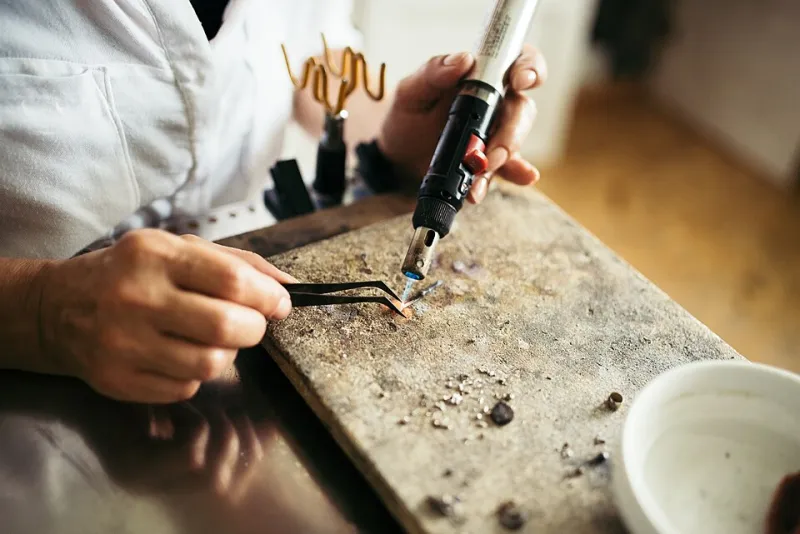
Photo by Photo by Compagnons on Unsplash on Unsplash
There's a version of the creative process that most of us carry around in our heads, and it goes something like this: artisan gets idea, artisan makes thing, thing is beautiful, the end. It's tidy. It's also completely wrong.
The truth lives in a battered sketchbook that sits open on the bench here at DeLari, coffee-ringed and swollen with graphite dust. And we thought it was time you got to flip through it — because once you see how ideas actually happen, you'll never look at a finished piece the same way again.
Three Designs, Three Very Different Journeys
Design one: the commission that fought back. A client wanted a signet ring inspired by the coastline of her grandmother's property in Maine. The first sketch? A literal outline of a coastline. It's fine. It's also boring, and the margin note next to it — in our lead designer's handwriting — just says "too much like a map, less like a memory." It took eleven sketches before the coastline dissolved into something abstract: a carved ridge of negative space that catches light the way water does at dusk. The winning sketch is barely a drawing at all. It's three lines and a smudge.
Design two: the wax that died. Not every idea survives the sketchbook-to-wax stage. We still have a rejected wax model for a pair of earrings on the shelf — carved, finished, technically flawless, and completely lifeless. The sketchbook page next to it reads: "Everything right, nothing alive. Start over." That's not failure. That's the process doing its job.
Design three: the accident we kept. A prong setting sketched at the wrong angle became the whole point of a solitaire we now make regularly. The original mistake is still visible in the notebook, circled twice, with an arrow and the word "YES" scrawled beside it.
Why the Failures Are the Signature
Here's the argument at the heart of this piece: a maker's real fingerprint isn't in their successes — it's in their pattern of rejections. What a jeweler consistently says no to shapes their work more than what they say yes to. That's something no machine can copy, because a machine doesn't have taste. It doesn't have a morning where it looks at a wax model and feels vaguely annoyed.
When you buy original work, you're not just buying an object. You're buying the eleven sketches, the dead wax, and the accident somebody had the sense to keep.
What This Means When You're Shopping
Mass-produced lookalikes are designed to skip all of this. They're answers to questions nobody asked. There's nothing wrong with them, exactly — but there's nothing in them, either. If you've ever held a handmade piece and felt it was somehow denser than it should be, that's not imagination. That's the weight of all the drafts it survived.
So the next time you're considering a piece of original work, ask the maker about the version that didn't happen. Watch what happens to their face. That's where you'll find out what you're really buying.