Before You Put Down a Deposit: Five Questions That Separate Real Makers from Good Talkers

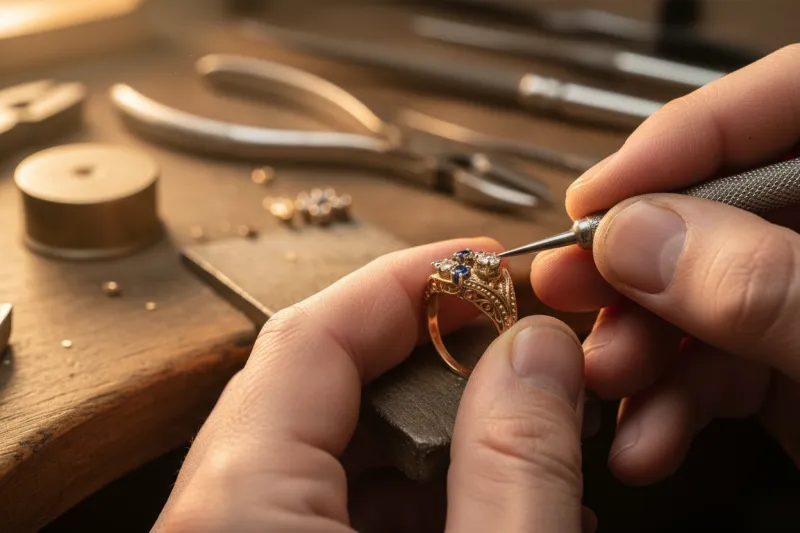
Photo by Photo by Vitaly Gariev on Unsplash on Unsplash
Let's be blunt: the handmade market runs on trust, and too often that trust is assumed rather than earned. Americans are commissioning more custom work than ever — jewelry, furniture, ceramics, lighting — and walking into those conversations with no playbook. As a studio that sits on the maker's side of the table, we think that's a problem worth fixing. So here's our playbook. Use it on us, too. We mean that.
1. "What's a realistic timeline, and what could push it?"
Green flag: A specific range with built-in honesty — "six to eight weeks, and if your stone needs to be sourced, add three." Real makers know where delays come from because they've lived them.
Red flag: "Two weeks, no problem." Speed is a sales tactic. Handmade work takes the time it takes, and a maker who pretends otherwise is either overbooked or overpromising.
2. "How many revisions are included, and what counts as one?"
Green flag: A clear answer, in writing, about what happens at each stage — sketches approved, wax or prototype approved, then casting or construction. Custom work should have checkpoints, and you should know when changes cost extra.
Red flag: "We'll just keep tweaking until you love it." Sounds generous. In practice, it means nobody defined the finish line, and that ambiguity lands on your invoice.
3. "Where do your materials actually come from?"
Green flag: Named suppliers, recycled or mined options explained plainly, and documentation for stones. A confident maker volunteers this without being pushed.
Red flag: Vagueness about provenance, or a story that shifts between emails. If someone can't tell you where the gold is from, ask yourself what else they haven't thought about.
4. "How do I care for this for the next twenty years?"
Green flag: A maker who talks about maintenance unprompted — how the patina will develop, when to re-polish, what to avoid at the gym. Care instructions are a sign the maker expects the piece to last, which tells you something about how it was built.
Red flag: Nothing. If the conversation ends at pickup and nobody mentions the future, the piece may not have one.
5. "What happens if I genuinely hate it?"
This is the question most people are embarrassed to ask. Ask it anyway.
Green flag: A calm, specific answer — usually about deposit structure, resale of materials, or revision paths — delivered without offense. Good makers have heard this question a hundred times and have a real policy.
Red flag: A visible flinch, or "that's never happened." Everyone in this business has had a piece miss. The difference between a professional and an amateur is that the professional has a plan for it.
Why We're Telling You This
Because a client who asks good questions is a client we can do our best work for. Transparency isn't a marketing angle — it's the whole contract. If a maker bristles at any of these five questions, that tells you what you need to know before a single dollar changes hands. And if they welcome them? You've probably found the right person.