Heavier Than It Looks: What Your Hands Know Before Your Eyes Do
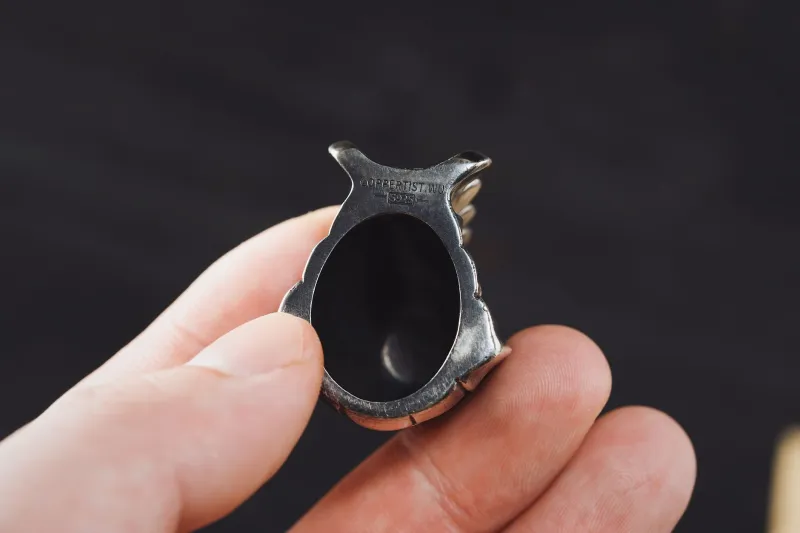
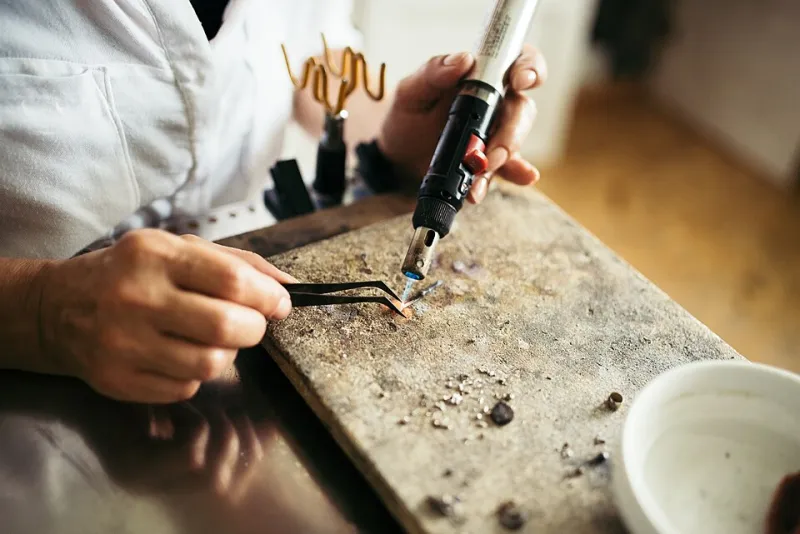
There's a moment in every consultation at our bench that we've come to anticipate. A client hands back a prototype — a heavy little band of silver, still warm from being handled — and pauses. Not to look at it. To feel it again.
"Huh," they usually say. "It's heavier than I expected."
We smile every time, because that pause is the whole point. Your eyes can be fooled by a good photograph and a flattering light. Your hands, it turns out, are much harder liars to.
The Physics of Expensive-Feeling
Density is one of those qualities that never makes it onto a product listing, but it quietly governs how a piece registers as "real." Solid sterling has a heft that hollow stamped equivalents simply can't match — a cast brass buckle from a heritage American workshop feels different in the palm than a zinc-alloy lookalike from a big-box shelf, even at identical dimensions.
Mass-produced jewelry is often engineered backward from a price point. Metal gets hollowed, thinned, or swapped for lighter alloys to shave fractions of a cent. None of that shows in a photo. All of it shows in your hand.
There's also balance. A well-made piece distributes its weight so it sits where it should — a pendant that hangs flat instead of twisting, a cuff that settles on the wrist rather than sliding around. That sense of a piece knowing where it belongs is the handcrafted tell that no marketing copy can fake.
A Field Guide for Your Fingers
You don't need a jeweler's loupe or a decade at a bench to develop this instinct. You need ten minutes in any department store jewelry counter and a willingness to pay attention. Try this:
The comparison lift. Pick up two visually similar pieces — one solid, one not — and hold one in each hand. Close your eyes. The difference isn't subtle once you're actually looking for it. Most people go quiet the first time they feel it.
The tap test. Gently tap a bangle against your knuckle. Dense metal gives a low, resonant note. Thin, hollow work answers with a flat, tinny clatter. Think of the difference between a good cast-iron skillet and a disposable one — same idea, smaller scale.
The warm-up. Solid metal warms slowly against your skin and holds that warmth. Lightweight pieces flash hot and cool fast, like they're barely there at all. Wear a heavy cuff for an afternoon and you'll notice you keep reaching for it — that's not sentiment, that's feedback.
The drape check. For anything on a chain, let it hang from your palm. Quality pieces fall in a clean line. Cheap ones kink, coil, and fight you.
Do this a handful of times and something shifts. Your hands start filing reports your eyes never got. Walk into any antique shop from Charleston to Santa Fe, pick up a hundred-year-old locket, and you'll understand immediately why these pieces survived: nobody saved the flimsy stuff.
Why Light Isn't Always Wrong
An honest caveat, because we'd never tell you heavier is a religion. Some pieces should be light — a large architectural earring made solid would be unwearable, and fine, airy filigree is a legitimate tradition with its own kind of mastery. The point isn't "heavy good, light bad." It's that weight should be intentional. Mass where it earns its keep, lightness where it serves the design.
What you're really training yourself to detect is deliberateness — the sense that someone made a series of small, stubborn choices about how this object should exist in the world. Density is just the most honest one, because you can't fake it without spending the metal.
The Palm as a Quality Control Department
Here's our favorite part: this skill costs nothing and compounds forever. Once your hands calibrate, you'll start feeling the difference in everything — flatware, doorknobs, the difference between a diner's stamped spoon and your grandmother's. It's a quiet form of literacy, and like most literacy, it makes shopping harder in the best way. You simply can't unfeel cheap.
So next time a piece stops you in a shop window, don't just look. Ask to hold it. Let it sit in your palm for a slow ten-count. If it settles in like it was waiting for you — weighty, balanced, warm — trust that. Your hands got there first, and they're rarely wrong.