The Old Steel: Meeting the Five Tools That Do Our Quietest Work

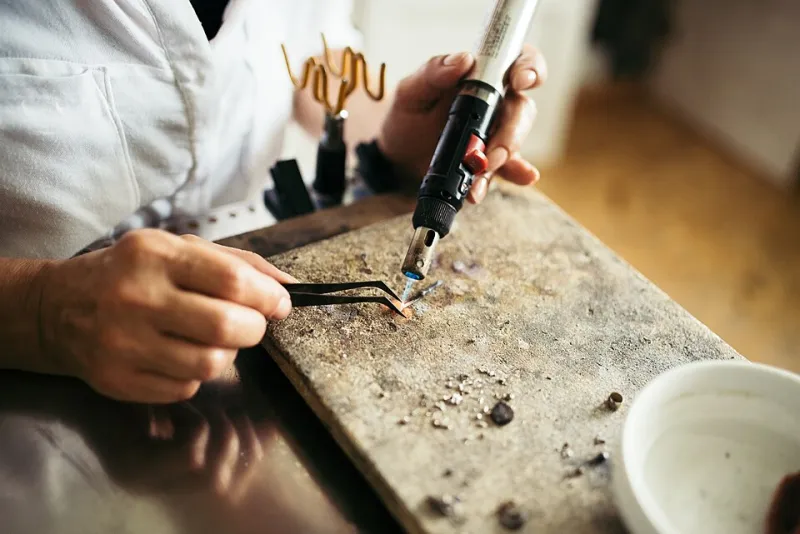
Photo by Photo by Bailey Alexander on Unsplash on Unsplash
Walk into most modern workshops and you'll find the same story: shiny machines, digital calipers, equipment with warranties. Walk into ours and you'll find some of that too. But scattered along the bench, between the new tools, sit a few pieces of steel that have been doing this work longer than the building has been standing.
They're not decorations. Every one of them is in weekly — usually daily — use. Here are five we thought you should meet.
The Chasing Hammer, Circa 1880s
The oldest tool on our bench has a head worn smooth as a river stone and a handle wrapped in what we believe is original leather. Chasing hammers are workhorses — they flatten, texture, and coax metal into shape — and this one has likely shaped more silver than most studios produce in a decade.
Our lead setter, Renata, reaches for it instinctively. "The weight distribution is just right," she says. "Modern hammers are close. Close isn't the same." The handle has darkened to a warm brown from a century of hands, and there's a small dent near the face that she swears helps her feel the strike. We don't argue with a hundred and forty years of evidence.
Great-Grandmother's Burnisher
A burnisher is a simple thing — a curved steel blade, polished to a mirror, used to press bezels down tight around a stone. Ours belonged to the great-grandmother of a former apprentice, who left it with us when she moved abroad, on the condition that it never sit in a drawer.
It hasn't. It's the tool that sets the final stone on nearly every commission we finish. There's a particular satisfaction in using a burnisher that has closed bezels on jewelry now sitting in attics and estate collections across the country. Someday, pieces it touched today will be someone's inheritance.
The Dividers With the Brass Thumbscrew
Measuring tools don't get sentimental attention, but ours should. These dividers — used to scribe perfect circles and transfer measurements — date to roughly the 1920s, with a brass thumbscrew worn to a shape that fits a thumb better than any modern knurled knob.
Precision tools either stay true or they don't, and these have stayed true through a century of hands. When a client asks how we get our symmetry so exact, the honest answer is partly "an old tool that refuses to drift." New dividers work fine. These work like they've got something to prove.
The Ring Mandrel With a History We Can't Verify
This one we bought at an estate sale in Lancaster County, Pennsylvania, from a seller who claimed it came out of a retired jeweler's workshop. We can't prove any of the story. What we can prove is that the steel is dense, the graduations are still legible, and it gives us a truer read on ring sizing than the aluminum mandrels we keep as backups.
It has a faint initials stamp near the base — "H.R." — and we think about H.R. more than we probably should. Whoever they were, they picked well.
The Polishing Motor's Grandfather: A Hand-Cranked Tumbler
The newest-old tool in the rotation is a hand-cranked barrel tumbler, likely early twentieth century, that we use for small batches of finishing. Yes, we have an electric tumbler. No, we don't use it for the pieces that matter most.
There's something about the rhythm of the crank — slow, steady, unhurried — that matches the pace of the work. Our apprentice calls it "the meditation shift." We've noticed that pieces finished in the old tumbler get a slightly softer, more lived-in glow, which suits a studio built on the idea that things should look like they belong in a life, not a display case.
Why We Don't Upgrade
The honest answer is part practicality, part philosophy. Practically: old steel that has stayed true for a century is a known quantity, and well-maintained hand tools often outperform their modern equivalents. Philosophically: a studio about handmade things should be honest about its own hands, and hands learn differently on tools that carry history.
Every piece that leaves DeLari Studio passes through steel that has outlived its makers. We find that fitting. Good things, made slowly, tended by tools that were tended — that's the whole idea, really. The old steel just keeps reminding us.