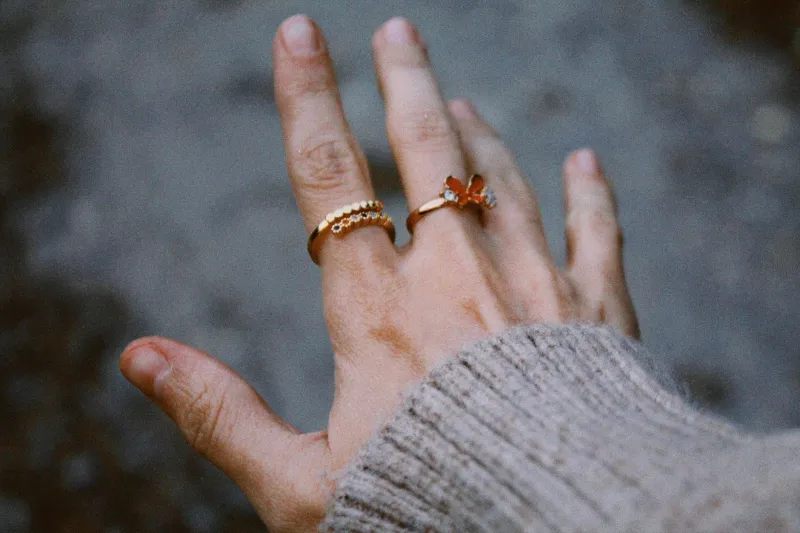
The Lamp Lied: Judging Jewelry in the Light You Actually Live In

There is nothing sinister about a jewelry display case. The lighting in a good store is doing what good lighting has always done: flattering the subject. It makes gold look warmer, diamonds look livelier, and a brushed finish look almost supernatural. But you are not buying a display case. You are buying a ring you will wear while chopping onions, a necklace you will catch in the bathroom mirror, a pair of earrings that will spend most of their life under office fluorescents. The piece has to work in your light, not the store's.
That is the whole argument here. Judge jewelry at its worst light, not its best. A piece that still feels right in a gray winter afternoon or the harsh glow of a parking garage is a piece you will actually reach for. A piece that only sings under a halogen spotlight is a very expensive lesson in disappointment.
Start with the window walk
Before you commit to anything, ask to take it to the window. Most jewelers will say yes; a few will hesitate, which is useful information in itself. Stand in natural light — ideally outside the door if the store allows it — and look at the piece the way you would look at it on your own hand at home. Overcast daylight is especially honest. It does not add sparkle. It shows you the true color of the metal and the stone, the way the finish catches (or does not catch) the light, and whether the proportions feel as good when the spotlight is gone.
Do the window walk twice: once at a glance, once up close. The glance tells you if the piece has presence. The close look tells you if it has manners — smooth edges, a clasp that sits flat, a setting that does not snag on your sleeve.
The phone-photo check is a truth serum
Your phone camera is not a professional jeweler's loupe, but it is a useful liar-catcher. Take a photo in the store's light, then take one near the window. No flash, no filters, no zooming until later. Look at the two images side by side. You are not checking for photogenic quality. You are checking for color shift.
Metal tones move under different light sources. Yellow gold can turn brassy under warm bulbs and softer under daylight. White gold and platinum pick up whatever is around them — a gray wall, a green plant, the blue of your phone screen. Rose gold can look almost peach in one room and strangely muted in another. Stones do the same thing. Sapphires go inky indoors and bright at the window; pearls seem to glow in soft light and go chalky under fluorescents. The phone photo exaggerates some of this, which is exactly why it helps.
Borrow a sweater — preferably your own
The borrowed sweater test is simple: bring a piece of clothing you actually wear, or ask to hold the jewelry against a sweater or scarf the store has on hand. Better yet, wear the neckline or sleeve you wear most often. Jewelry does not exist in a vacuum. It sits against skin, fabric, hair, and whatever color you happened to put on that morning.
Hold the piece against the sweater. Does the metal tone feel intentional, or does it fight? Does the stone disappear into the fabric, or does it hold its own? If you are trying on a necklace, wear a top with a similar neckline to what you wear on a normal Tuesday. A pendant that looks elegant against a black turtleneck may look fussy against a white tee. That is not a flaw in the piece. It is information about where it belongs in your life.
Metal has a mood, and light changes the cast
Most buying advice treats metal as a fixed fact: yellow, white, rose. In reality, metal is a surface. High-polish finishes bounce light and show every fingerprint; brushed finishes absorb light and hide small scuffs; textured finishes can look dull in a dim room and beautiful in daylight. If you are choosing between two similar pieces, look at them in the same light at the same time. The one that looks richer by the window is usually the one that will look richer on your hand at home.
Stone color is even more sensitive. A stone that looks vivid in the case may calm down considerably in your living room. That is not necessarily bad. Some stones are meant to be subtle. But you should know which effect you are buying. Ask the jeweler to show you the piece under a cooler light and a warmer one, then take it to the window. If the color still pleases you in all three, you are in good shape.
The three-light rule
Before you decide, see the piece in at least three kinds of light: daylight, office fluorescent, and warm dim light. You can approximate this in the store by walking to the window, standing under a ceiling panel, and stepping into a corner away from the display spots. If the store has a candle or a warm table lamp, even better. The restaurant-candle test matters because that is where a lot of jewelry actually gets worn — close to the face, in low light, after a long day.
This is not about finding a piece that looks perfect everywhere. Nothing does. It is about finding a piece that never looks wrong. The right jewelry should not require a specific lamp to justify itself.
What to ignore, and what to trust
The first flash of sparkle is not a verdict. It is a sales tactic, even when no one is trying to sell you anything. Step back. Blink. Look at the piece at rest. Trust the window, the phone photo, the sweater, and your own squint. If you have to talk yourself into it under gray light, you will be talking yourself into it for years.
At DeLari Studio, we like pieces that look lived in, not staged. Handcrafted jewelry should survive the kitchen, the commute, the bad hotel mirror, and the gray Tuesday afternoon. So before you buy, take it to the window. Let the lamp lie to someone else.